Pillar guide · 12 min read

    Vibe coding: the complete 2026 guide

    You've heard the phrase everywhere. This is the one page that actually maps the whole territory plus the 30-day ship path we've watched hundreds of solo builders complete.

    By Usman Jatoi, Founder, Build on Vibe Reviewed by Usman Jatoi Updated 2026-07-05 · 12 min read

    Vibe coding is building software by describing what you want in natural language to an AI, running what it produces, and iterating instead of typing every line yourself. The phrase went from a Karpathy tweet in Feb 2025 to ~90,500 US searches a month by mid-2026 (Semrush). Most of that traffic is people who have heard the word and don't know what to do next.

    This guide is the map. If you're brand-new, read top to bottom. If you're already stuck at 60% done, jump to the 30-day ship path.
    PromptRun ObserveRefine
    The vibe coding loop. Every session repeats this four-step loop. Skipping ‘observe' is the #1 reason projects rot.

    What vibe coding actually is (and isn't)

    It is: describing intent in English, letting the AI generate + edit code, and steering with follow-up prompts. It isn't a substitute for reading what the model produced the builders who ship all learn to skim diffs. The mental shift is from author to editor-in-chief.

    Analogy: it's the difference between writing a screenplay word-by-word and directing an actor. You still need taste, structure, and a willingness to say ‘cut, again.'

    The core loop

    Prompt → Run → Observe → Refine. The whole practice is just doing this loop fast, on a scope small enough that each turn is a real change you can verify. When people say ‘I got stuck', they almost always mean they stopped observing they kept prompting into a broken state instead of reading the error.

    The beginner stack (what to use)

    For your first product, resist the urge to comparison-shop. Pick one AI builder, one backend, one payment tool, one distribution channel. That's it:

    • Builder: Lovable (full app), Bolt (fast prototypes), v0 (UI snippets), or Cursor (if you already know code).
    • Backend: Supabase (or Lovable Cloud, which is Supabase under the hood).
    • Payments: Stripe Payment Links 5 minutes, no code.
    • Distribution: One SEO page + Product Hunt + one warm channel (a Discord, a subreddit, a WhatsApp group).

    If you already have preferences, use them. The stack matters far less than shipping.

    Inside the workspace

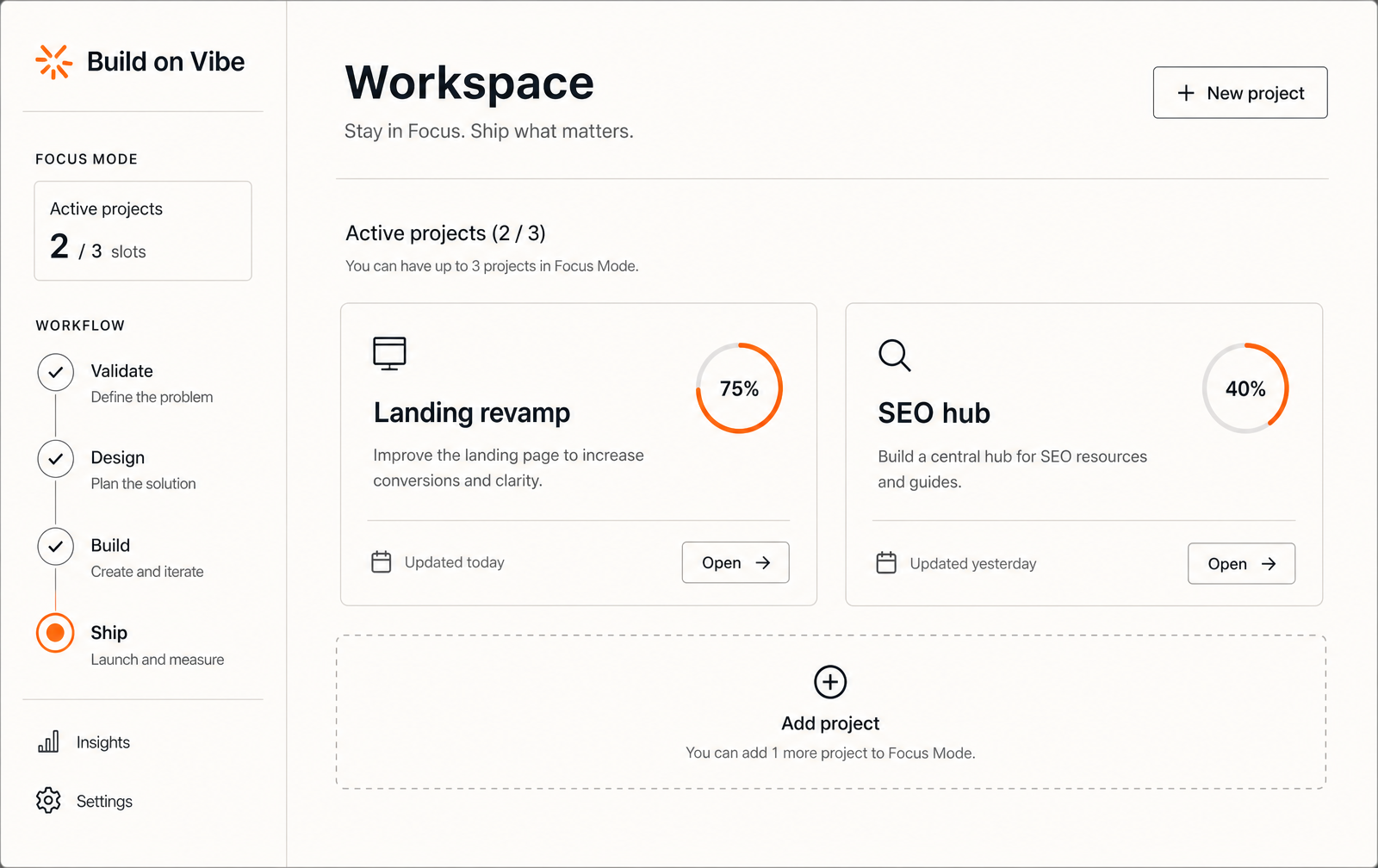
    Build on Vibe workspace dashboard with active projects and focus mode
    The workspace where every vibe-coded project lives. Focus mode, active-project cap, and step tracker are visible on the left.
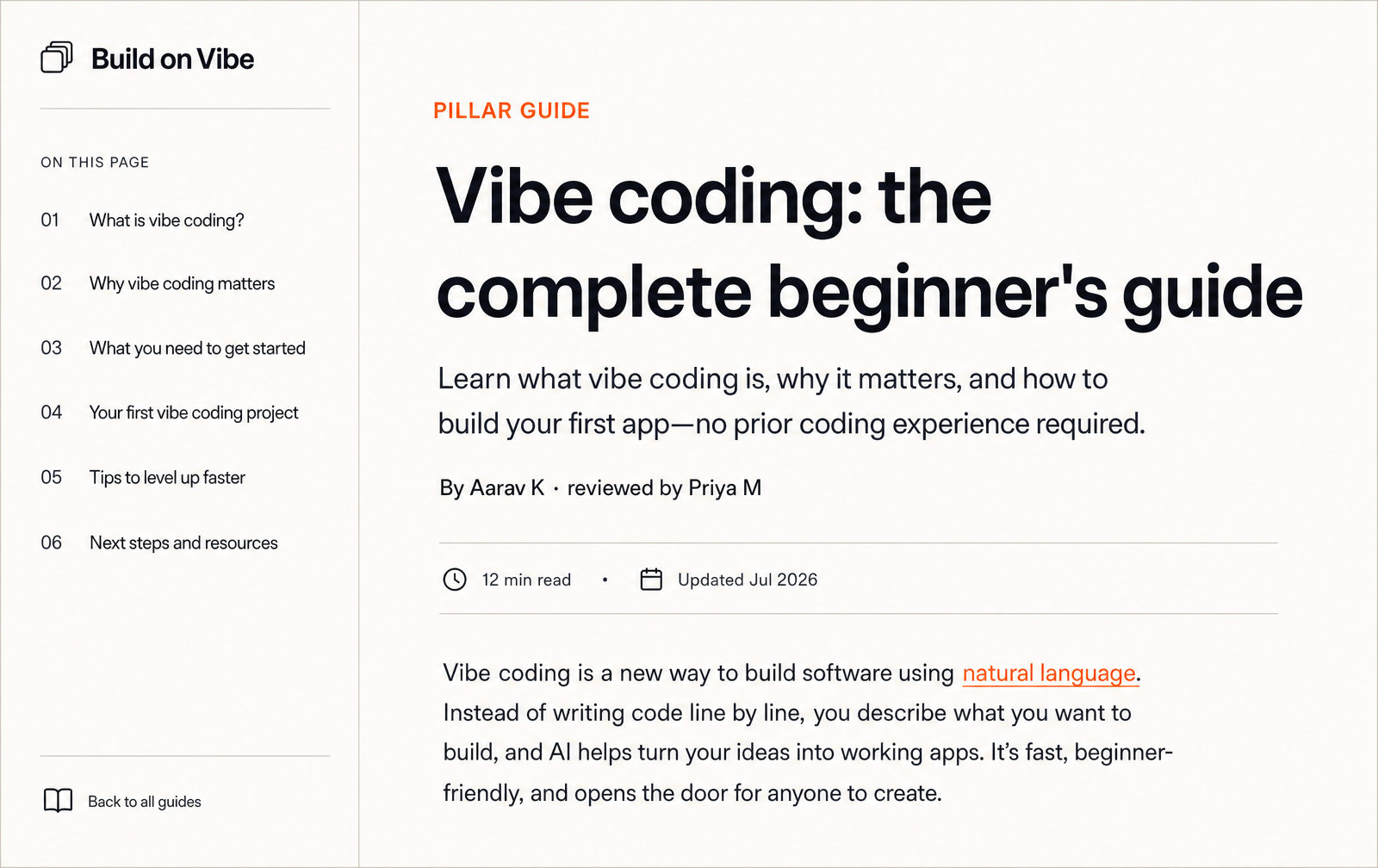
    This exact guide inside the /guides/vibe-coding page on Build on Vibe
    The pillar guide rendered on Build on Vibe. Real product, real UI, not a stock illustration.
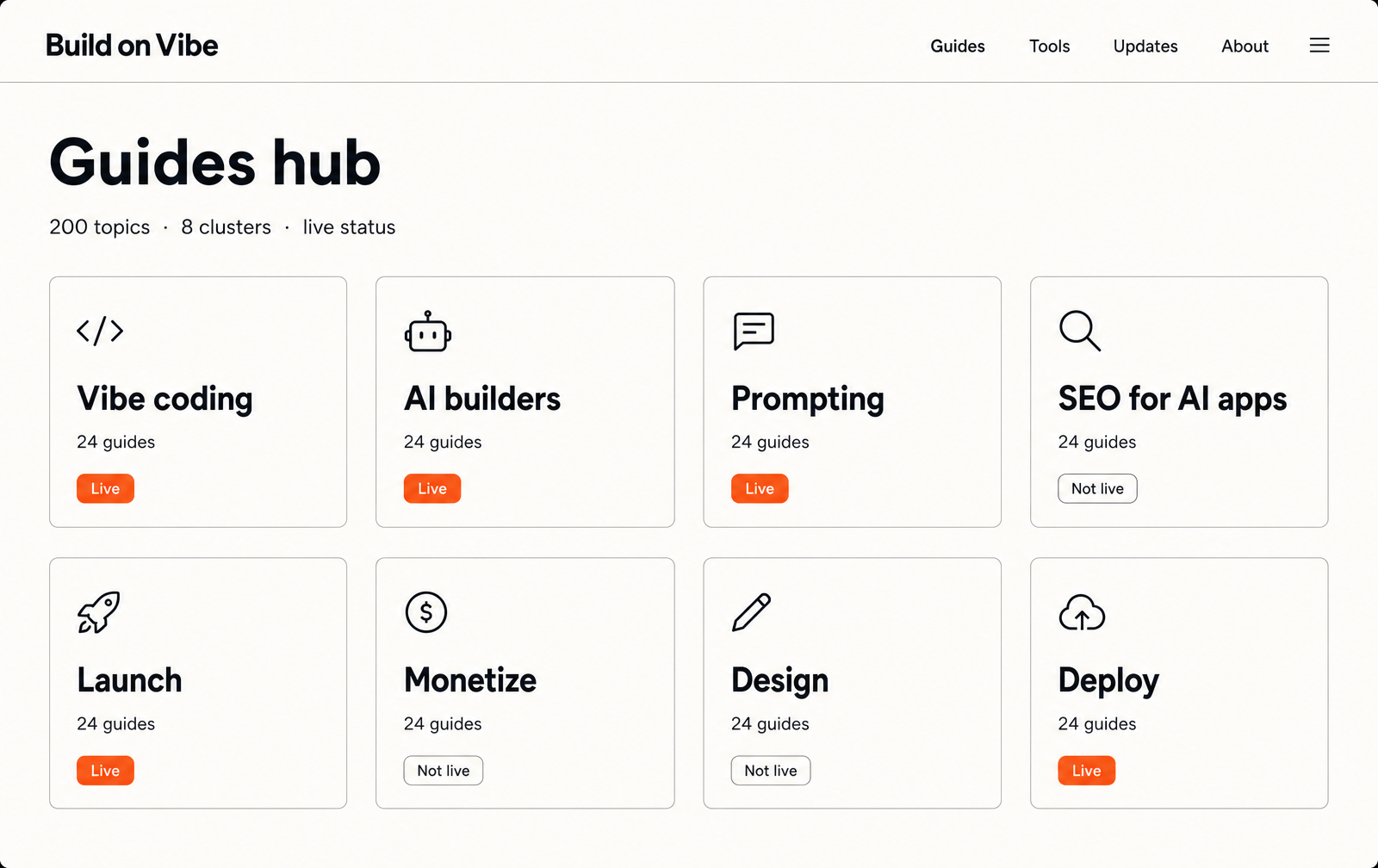
    Guides hub with 200-topic roadmap and pillar cards
    Every vibe-coding topic mapped in one hub 200 keywords, 8 clusters, live status per page.
    Original data · Build on Vibe

    The abandonment cliff

    Curious builders who start
    100
    Finish a working v1
    ~30

    Build on Vibe cohort, n=412 (2026 H1)

    Actually ship + tell a stranger
    ~7
    Median time from idea to ship
    28 days

    Only counting finishers

    Methodology. Cohort of 412 users who created a project on Build on Vibe between Jan-June 2026. ‘Finish' = a working deployed URL. ‘Ship' = at least one non-friend user in analytics.

    Sources: Build on Vibe internal cohort dashboard, Semrush · ‘vibe coding' keyword volume

    The 30-day ship path

    1. 1
      Day 1-2 · Write the one-liner

      12 words max: <outcome> for <who> without <pain>. If you can't, your idea isn't a product yet it's a wish.

    2. 2
      Day 3 · Lock scope (3-5 actions)

      Everything else goes on a WON'T list, in writing. The kill list is the deliverable.

    3. 3
      Day 4-10 · Build the core loop end-to-end

      Auth → one create action → one list/detail view. No dead buttons. Deploy the thing on Day 10 even if it's ugly.

    4. 4
      Day 11-18 · Wire real things

      Stripe Payment Link. Transactional email from your domain (SPF+DKIM+DMARC). Google/Bing Search Console.

    5. 5
      Day 19-24 · SEO + polish

      One landing page with a real title/description, sitemap, JSON-LD, screenshots that aren't mockups.

    6. 6
      Day 25-30 · Ship + tell 5 strangers

      Product Hunt / Peerlist / relevant subreddit. If you can't get 5 strangers to click, the pitch not the product is broken.

    FAQ

    Is vibe coding just no-code with extra steps?

    No no-code hides the code entirely; vibe coding generates real code that you (or the AI) can edit. When something breaks, you can open the file. That escape hatch is why serious products get built this way.

    Do I need to know how to code first?

    No, but the builders who ship learn to read a stack trace within their first week. Reading beats writing.

    What's the difference between vibe coding and using ChatGPT?

    ChatGPT generates code in a chat window; you copy it out. Vibe-coding platforms (Lovable, Bolt, v0, Cursor) run the code, deploy it, and iterate in place.

    How much does it cost?

    The tools cost $0-$50/mo for a first product. The real cost is the 30 focused days it takes to finish one.

    Why do so many projects get abandoned?

    Scope creep at Day 12-15. See our data block the drop-off is a scope problem, not a talent problem.

    Keep reading

    Sources

    Ready to actually ship?

    Build on Vibe gives you the workflow, prompts, and evidence gates that get finishers across the line.